The Ecology of Andros
Contents
Caverns abound and so does diversity of life.
Description
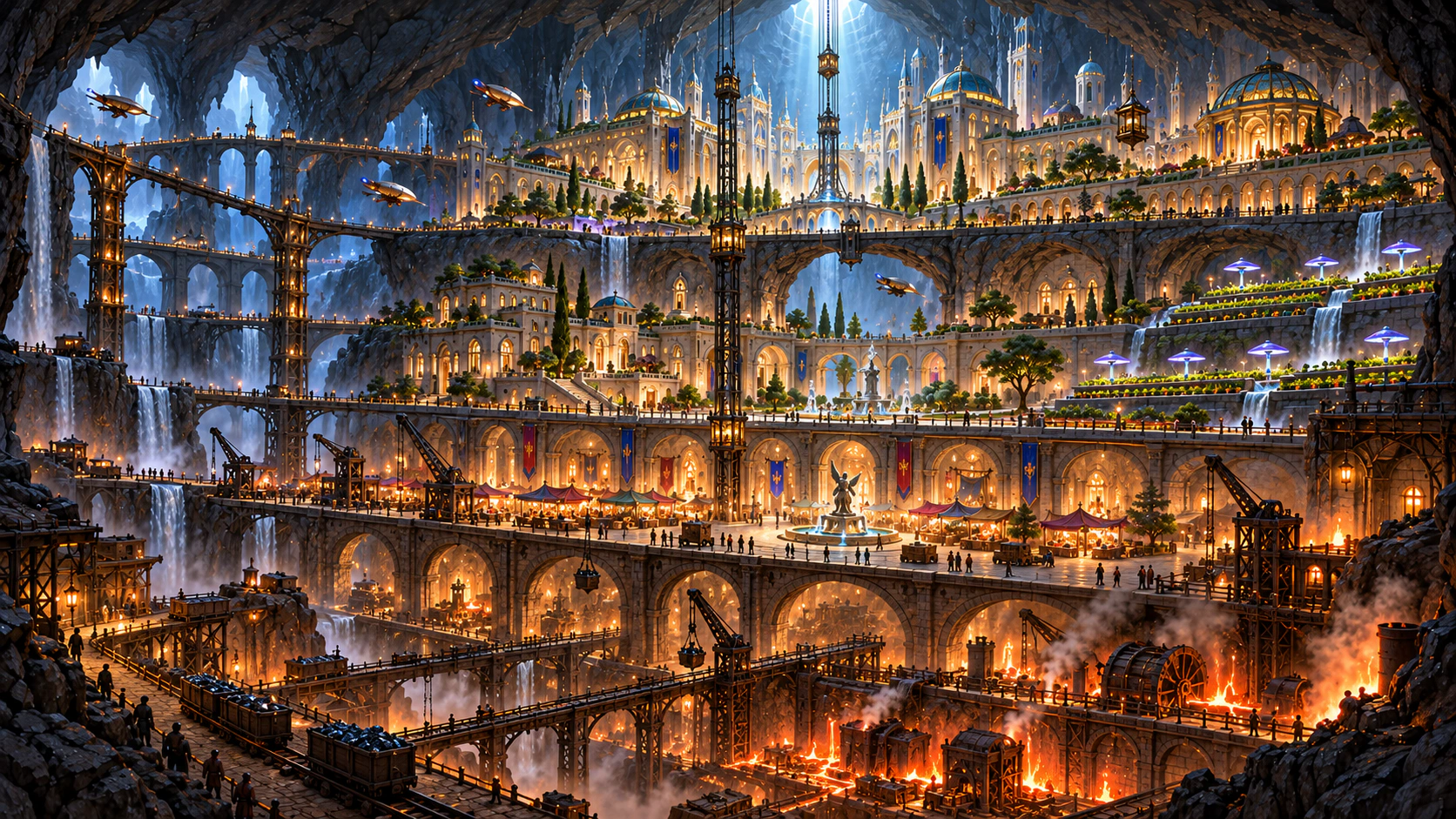
Andros is a vast subterranean metropolis buried deep within the mountains of Galdor. Though connected to the surface through heavily traveled trade routes, the city has developed an artificial ecosystem capable of sustaining an enormous permanent population underground.
Everything in Andros flows vertically. Light, water, food, goods, waste, and people move between the city’s tiers, creating an interconnected system in which very little can afford to be wasted.
Light
The city’s daylight comes from the Helios Engine, a colossal machine built around an enormous piece of refined Sunstone.
Helios travels along a massive arcane track across the ceiling of Andros’s central cavern, recreating the movement of the surface sun. Its journey is synchronized with the actual daylight hours above Galdor, allowing the city’s work schedules, markets, imports, exports, and biological rhythms to remain aligned with the surface.
At night, Helios disappears into its western cradle and the Constellation Network takes its place.
The Constellation Network is a vast web of smaller Sunstone-powered lamps, crystals, streetlights, architectural fixtures, and interior lighting spread throughout Andros. From across the cavern, thousands of lights appearing after Helios sets resemble stars emerging across a night sky.
Because Andros is built vertically, access to Helios’s light varies significantly. The Crown receives brilliant artificial daylight while the lowest portions of the Deepworks may rely upon the Constellation Network even at noon.
Water
Mountain water enters Andros through underground rivers and enormous engineered aqueducts.
Clean water begins in the upper city before descending through reservoirs, fountains, homes, workshops, agricultural terraces, and finally the industrial systems of the Deepworks.
Waterfalls are therefore common throughout Andros. Some are natural, while others are deliberate portions of the city’s infrastructure.
The lowest levels contain extensive filtration systems using gravel, charcoal, alchemical treatments, and specially cultivated fungi before water is released back into the surrounding cavern system.
Food
Andros imports large quantities of fresh food from the surface, but the city’s population is far too large to depend entirely upon outside agriculture.
Much of its food is produced within enormous subterranean agricultural terraces known as the Verdant Galleries.
Smaller Sunstone-powered agricultural lamps imitate daylight over fields of dwarf wheat, beans, root vegetables, cavern squash, herbs, fruiting vines, and other crops adapted for underground cultivation.
Irrigation channels and watering stations distribute water throughout the terraces.
Fungi form another major component of the Androsian diet and agricultural system.
Stonebread is a cheap edible fungus commonly eaten throughout the lower city.
Ashcaps thrive near industrial areas and help absorb airborne pollutants.
Blue Lantern Mushrooms produce faint natural illumination.
Grave Mold rapidly breaks down organic matter and is heavily used in waste processing.
Countless other species are cultivated for medicine, dyes, alcohol, livestock feed, alchemy, and food.
Livestock
Traditional livestock exists in Andros but space and feed requirements make large animals expensive.
Goats, pigs, and chickens are common.
Several species originally recovered from the dungeon below have also been domesticated.
The most successful is the Cave Strider, a squat six-legged herbivore capable of surviving primarily on fungi and agricultural waste. Cave Striders provide meat, milk, leather, and limited labor and have become an important part of everyday life in the lower city.
Urban Wildlife
Despite its engineered environment, Andros possesses a thriving urban ecosystem.
Tunnel Rats infest warehouses, mines, abandoned passages, and sewage channels.
Lantern Moths gather around Sunstone lighting and sometimes interfere with the Constellation Network.
Stonebacks are small armored insects that consume mineral deposits and occasionally damage masonry.
Large colonies of Cavern Bats inhabit the unreachable heights of the Great Cavern and help control insect populations.
Creatures from the dungeon below also occasionally establish populations within abandoned tunnels, drainage systems, mines, and forgotten portions of the Deepworks.
Air and Heat
Airflow is one of Andros’s greatest engineering challenges.
Enormous ventilation shafts connect portions of the city to the surface while mechanical fans, arcane turbines, and carefully designed thermal channels circulate air between levels.
The Deepworks produces tremendous amounts of heat through mining, smelting, industry, machinery, and geothermal activity.
Much of this heat naturally rises through the city.
Some is captured and redirected into homes, baths, greenhouses, workshops, and water systems before eventually escaping through upper ventilation shafts.
As a result, each tier possesses a slightly different climate.
The Deepworks is hot, smoky, and humid.
The Mercantile Quarter is warm and crowded.
The Hearthstone District is considerably more comfortable.
The Crown enjoys the cleanest air and most carefully regulated temperatures.
Waste
Andros survives by wasting remarkably little.
Food scraps become livestock feed or fungal substrate.
Organic waste becomes fertilizer.
Metal is reclaimed and reforged.
Wood is reused or converted into fuel.
Ash becomes part of construction materials.
Bones are processed into fertilizer, tools, alchemical materials, and industrial products.
Entire businesses exist solely to reclaim useful material from the city’s refuse.
Like almost everything else in Andros, waste flows downward.
The poorest districts therefore perform much of the labor required to process what the upper city discards.
The Dungeon Below
The enormous dungeon beneath Andros has become inseparable from the city’s ecology.
Dungeon organisms have been domesticated.
Dungeon fungi have entered agriculture.
Dungeon minerals power city infrastructure.
Explorers carry surface organisms downward while returning with new species, spores, parasites, and materials.
Waste and runoff from Andros enter portions of the upper dungeon, while creatures from below migrate upward through mines, waterways, ventilation systems, and forgotten passages.
Centuries of contact have gradually blurred the ecological boundary between city and dungeon.
Andros is therefore neither entirely a surface civilization nor a natural subterranean ecosystem.
It is something uniquely its own:
a living city beneath the mountains, sustained by the surface above, powered by the depths below, and held together by an artificial sun moving slowly across a stone sky.